
At 2:13 a.m., a creator I’ll call Maya stared at her phone and felt her stomach drop. A subscriber had sent a screenshot of what looked like a direct message thread on OnlyFans, complete with her profile picture and a familiar display name. In the image, “Maya” appeared to be offering a steep discount for explicit content in exchange for payment sent off-platform. The subscriber was angry, convinced she was trying to scam him.
Maya insisted she never sent it. She did not even use that phrasing. But screenshots have a stubborn authority. They are tidy, portable, and persuasive in a way a denial rarely is. The next morning, another person appeared in her inbox: a potential collaborator asking if the screenshot was real. Then a third. The scam was not just about money. It was about trust. And trust is the real currency on subscription platforms.
This is what the new wave of screenshot scams looks like: forged conversations that weaponize the visual language of authenticity. On OnlyFans, where private messaging is central to the business, a plausible fake can do real harm in minutes.
The anatomy of a “conversation” that never happened
Most people treat chat screenshots like receipts. They read them as if the camera itself is a neutral witness. But anyone who has worked a newsroom, moderated a community, or handled a messy dispute between strangers knows the truth: a screenshot is not evidence by default. It is a claim.
What makes the current moment different is how easy it is to generate that claim. In the past, forging a chat meant either editing an image (often sloppily) or using dev tools and a bit of design skill to fabricate something believable. Now you can build a high-resolution “proof” in the time it takes to make coffee.
Tools marketed as chat generators have legitimate uses. Writers storyboard scenes. Teachers create classroom examples. Brands mock up UI concepts. Comedians rely on fake messages for sketches. The problem is not the existence of the tool. It is the frictionless path from “I wonder if I could” to “I have an image that looks real enough to ruin someone’s day.”
One popular site openly offers an OnlyFans interface among many others. With a few clicks, you can produce a fake OnlyFans chat that includes the familiar message bubbles, timestamps, usernames, and the subtle spacing quirks people have been trained to trust. The interface is so clean it feels like a toy, which is exactly why it can become a weapon in the wrong hands.
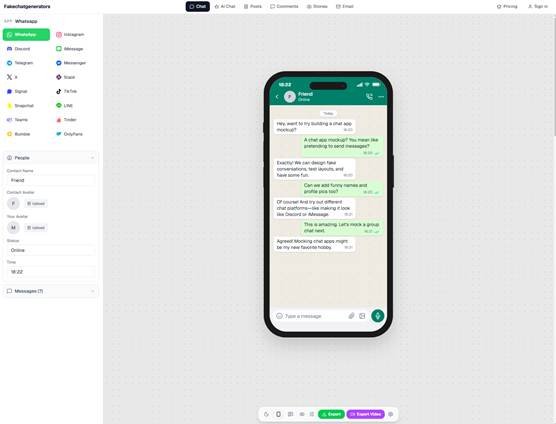
fakechatgenerators.com lets you mock up chat screenshots across 16 platforms
Once created, the screenshot gets deployed in predictable ways: sent to subscribers to pressure a refund, posted in forums to “warn” others about a creator, forwarded to partners to provoke panic, or used as leverage in extortion attempts. The scammer does not need to hack an account. They just need to fabricate a plausible narrative.
Why OnlyFans is a particularly ripe target
OnlyFans sits at an intersection of intimacy and commerce. The platform is built on private access, on one-to-one communication, on the idea that the person behind the screen is real and responsive. That is the product.
That structure creates a few vulnerabilities:
- Disputes are personal, fast, and emotional. A subscriber who feels cheated rarely reacts like a neutral consumer. They react like someone betrayed. A forged message can ignite that feeling.
- Creators often operate as small businesses of one. There is no PR team, no customer support department, no legal counsel on standby. If a rumor spreads, the response time is limited by sleep, work, and sheer exhaustion.
- Stigma does some of the scammer’s work. People outside the platform can be quick to believe the worst, and creators can be hesitant to push back publicly. In an environment where reputational harm can spill into family life or a day job, silence can feel safer, even when it allows a lie to stand.
- The off-platform payment trap is familiar. Many users have heard “never pay via gift cards” or “don’t send money on Cash App,” but when it appears in a screenshot under a creator’s name, the warning gets blurry. Scammers lean on that confusion.
The result is a kind of low-cost, high-impact fraud. It is low-cost because it requires no access to the platform. It is high-impact because it exploits the social contract that keeps subscription businesses running.
The new burden of proof
When a screenshot can be fabricated easily, the burden shifts to the person accused. That is the cruel logic of these scams. The creator is asked to prove a negative: prove they did not send a message, did not offer a deal, did not use that language, did not ask for that payment method.
Some creators respond by sending screen recordings of their inbox. Others send export logs if the platform provides them. Some take their phones to a second camera and record themselves scrolling, trying to add a layer of “liveness” that a static image lacks. It helps, sometimes. But it is also exhausting, and it rarely reaches everyone who saw the forged screenshot in the first place.
Meanwhile, scammers exploit the ambiguity. They do not need their image to survive close forensic analysis. They just need it to survive long enough to get a refund, an off-platform payment, or a moment of leverage.
And in a crowded online marketplace, a moment can be plenty.
How forged screenshots are used, in practice
The scams tend to fall into a few buckets, each with its own logic.
Refund pressure and chargeback theater
A subscriber claims they were promised a certain type of content, or a discount, or a “custom,” and presents a screenshot as proof. If the creator refuses, the scammer threatens a chargeback or a public post calling the creator a thief. The screenshot is less about convincing the creator than it is about intimidating them.
Off-platform payment bait
The forged chat instructs the victim to pay via a third-party app “because OnlyFans is glitching” or “for privacy.” This is a classic move across marketplaces, but in adult content it can be more effective because people are already anxious about discretion. Scammers use that anxiety.
Extortion and reputational threats
The scammer sends the creator the fake screenshot and claims they will share it with subscribers, family, or employers unless paid. Sometimes the screenshot includes language designed to maximize shame. This is not always about money. It can be about control.
Creator-on-creator sabotage
Not every scam targets subscribers. Some target creators by poisoning their reputation in niche communities where word travels quickly. A forged screenshot can be posted as “proof” of bad behavior: scamming, racism, content theft, even illegal offers. The goal is to isolate a competitor.
The detective work behind a single image
A serious investigative approach to a screenshot starts with a basic, often uncomfortable question: what would it take for this to be real? Then it looks for the seams.
Some seams are visible to the naked eye:
- Typography and spacing: Is the font weight correct? Are the line breaks consistent with the app’s behavior?
- Timestamps: Do they follow the same format, time zone assumptions, and placement used in the real interface?
- Profile elements: Does the avatar crop correctly? Are icons sharp or slightly misaligned?
- UI inconsistencies: Does the screenshot mix elements from different app versions?
Then there is the deeper layer:
- Metadata: Many screenshots have minimal useful metadata, but sometimes images picked up from social platforms are recompressed, stripping clues. Still, the file history matters when available.
- Contextual cross-checking: If a message claims “I sent you the link yesterday,” does the alleged recipient have any corresponding message, notification, or evidence of contact?
- Pattern analysis: If multiple people receive “proof” with identical wording, identical timestamps, or identical typos, that repetition can be a fingerprint.
The challenge is that most victims are not forensic analysts. They are subscribers, creators, and moderators trying to make a judgment call quickly. Which is why automated tools are entering the conversation, for better and for worse.
Detection tools, and what they can and cannot do
Detection is often described as a silver bullet. It is not. It is a set of probabilities and signals. Still, in a world where fabricated media has become cheap, having any structured signal can change how disputes play out.
Some platforms and teams use dedicated services that scan images for signs of AI generation, manipulation, and document tampering. One example is ai image detection, which says it can flag AI-generated media, NSFW content, violence, and tampering, and claims 98.7% detection accuracy across more than 50 generative models, with sub-150ms latency. Those specifics matter because they speak to how these tools are marketed: as fast, scalable infrastructure for moderation queues, newsroom verification workflows, and trust and safety teams.
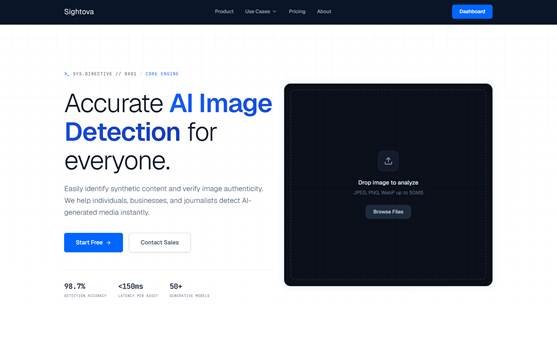
sightova.com flags AI-generated, tampered, NSFW, and violent imagery in milliseconds
But an important caveat: not every fake chat screenshot is AI-generated. Many are created through template-based generators or manual edits. An AI detector may help in cases where the screenshot is part of a broader AI-generated composite, or where the image itself has telltale signs of synthesis. It may also help triage large volumes of questionable images by surfacing anomalies faster than a human can.
The responsible use of detection tools looks less like “the tool decides,” and more like “the tool helps prioritize, and a human confirms.” In investigative terms, think of it as a lead, not a verdict.
What creators and subscribers can do right now
There is no single fix, but there are practical steps that reduce risk and limit damage when a forged screenshot appears.
For creators: build verifiable habits
- Keep communication on-platform. It is boring advice because it works. The moment you normalize off-platform contact, scammers gain cover.
- Standardize your language. Many creators already do this for efficiency, but it has a side benefit: if a fake screenshot uses wording you never use, you can point to a consistent pattern. It is not proof, but it is a clue.
- Use screen recordings when disputes arise. A recording that starts from the app’s home screen and navigates into messages is harder to fabricate convincingly than a single image. It is still not impossible, but it raises the bar.
- Document incidents calmly. Save the screenshot, the username, the date, and any related messages. If the scam escalates to extortion or coordinated harassment, you will want a timeline.
For subscribers: treat screenshots like claims, not receipts
- Ask for confirmation through the platform. If a screenshot says “pay me elsewhere,” send a message to the creator through the verified account and ask directly.
- Be wary of urgency. Scams often include time pressure: “last chance,” “right now,” “OnlyFans is down.” That urgency is a tell.
- Check for small inconsistencies. A weird timestamp, an icon that looks off, a username mismatch. Tiny errors matter.
For platforms and moderators: reduce the payoff
- Clarify refund and dispute processes. The less chaotic the system, the less leverage scammers get from threats.
- Educate users about off-platform payment scams. Not through generic banners nobody reads, but through targeted prompts when keywords appear.
- Support creator-facing verification tools. Even small features, like message authenticity markers or better logs available to creators, can shift the burden away from personal “prove I’m innocent” performances.
The uncomfortable conclusion
Screenshot scams thrive because they exploit something human: our habit of believing what looks familiar. A chat interface feels like a place where truth lives. But it is just a design, and designs can be copied.
The bigger story here is not OnlyFans alone. It is the erosion of visual proof across the internet, one plausible image at a time. For creators, that erosion translates into lost income, constant suspicion, and the slow fatigue of defending yourself against things you did not do. For subscribers, it means learning a new kind of caution in spaces that already feel private.
Tools that generate fake conversations are not going away. Detection systems will improve, then be tested by new tricks. The most realistic path forward is a mix: better platform safeguards, smarter moderation workflows, and a cultural shift in how we treat screenshots.
A screenshot can still be useful. It can still document real harm. But it is no longer the end of the argument. It is the beginning of an investigation.